

It goes on indefinitely… (Core of the review- part-2: Sudhir Panikkaveetil)

Manimalayaaru - Part Two
Within the span of an era, this describes the growth and progress of a village, blending its customs and way of life, historical facts, and imagination. Although the knowledge that the villagers built high walls using a mixture made from lime produced by burning shells and ghee obtained by killing the varal fish has faded with time, it still arouses the reader's curiosity. As it describes the mutual attacks of the local kings and their fleeing the kingdom for the interior regions, the training that the kalari schools provided to young people to resist the circumstances that arose from such events, and the women working tirelessly, we are reminded of the conveniences that technological progress provides them today. The novelist gives us the experience of an era actively transforming and disappearing before our eyes. Those villagers too move away from the riverbank and settle in the interior regions. In the novelist's words, the journey of humanity continues with the ringing of bells, in celebration, seeking new springs. Migration and its aftermath are the central themes of the novel from beginning to end.
There are also experiences that expatriates have in which everything they once considered their own is changed by time. Kochappu forbids the character Chathu from entering the river in which he himself had once bathed. When claimants come for everything, it is natural for the lord, the junior lord, and the servant relationship to emerge there. As the world grows, the novelist observes that "the wider world is never concerned with what happens to whom." In this chapter, what we see are the beliefs, knowledge, and progress of innocent villagers. They are people who always give priority to spirituality and desire goodness. Through knowledge, wealth accumulation, and teaching the Vedas, they built an elevated society. The novelist expresses their concerns very naturally. They wonder, "Where is the boundary of the world."? What inspired people to migrate may perhaps not have been only their dreams but also their anxieties and curiosity.
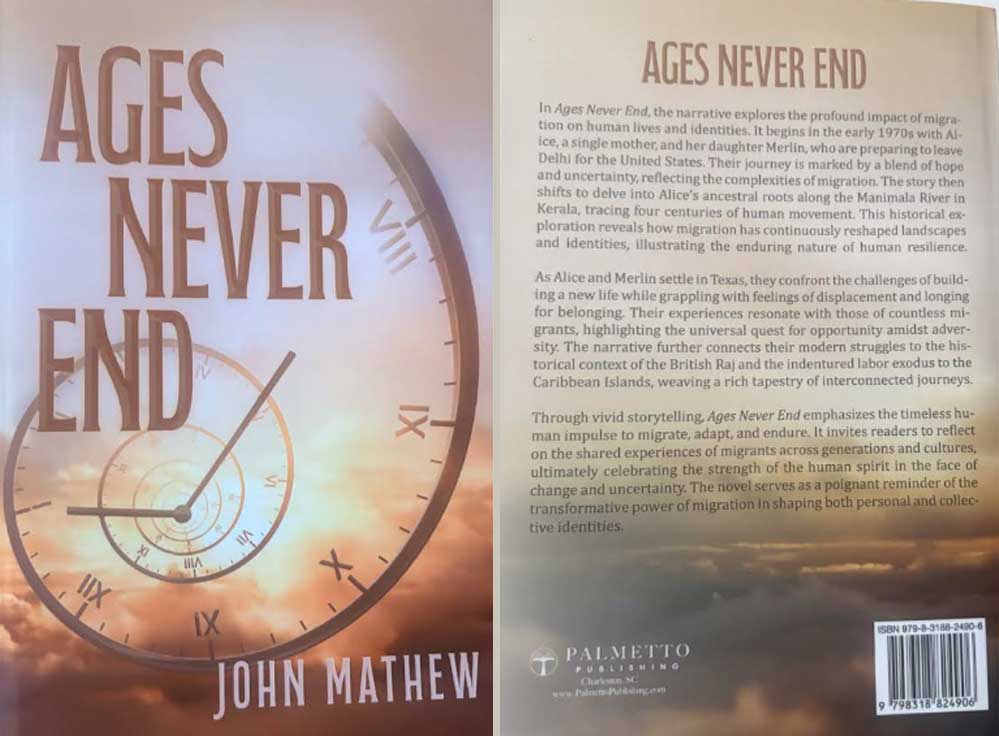
As the course of migration changes, contradictions emerge in people’s lives and thoughts. The novelist seeks to find beauty in these contradictions and express it artistically. He explains that the scenes we have seen and forgotten, or are still seeing, have broader dimensions than what we perceive. The answer to the question of whose land this is: if they are powerful, it belongs to those who came first or to those who later demonstrated their power. The novelist makes it clear to us that this is indeed true through the lives of those who lived on the banks of the Manimala River. In this chapter, “Manimala River,” the history of the challenges a village in Kerala went through and the influence of the social, cultural, economic, and interpersonal interactions it experienced are conveyed through a simple narrative.
Karadithodu - Part 3 - Alice has arrived in the wondrous world of America. Like S.K. Pottekkatt's Oru Desathinte Katha, this novel has a large number of characters. There are stories revolving around them. Nevertheless, the story develops through Alice, the protagonist. Like Pottekkatt, who had the skill of weaving a story together like twisting coir, Mr. John Mathew has interestingly narrated the stories that emerge through Malayalis, focusing on the theme of expatriation and Malayalis. The novelist tells us that Alice is laying the foundation stone for the immigrant society of the future. Another character in this, Eby, presents Alice's story at the literary gathering he attends. Eby, the writer who enjoys get-togethers with friends and picnics, Malayalamizes the name of the creek called Bear Creek as "Karadithodu".
The common characteristic of Malayalis of seeing the places, food, and even clothing of the land of expatriation through our language is manifested here. Nurses coming here and finding jobs, then going back home, getting married, and bringing their husbands over shows the continuation of expatriation. At the same time, the slanderous attitude directed toward women who live alone like Alice is also made clear through various structures. The conflicts of expatriate life and all the complexities that arise in their thoughts are described without sentimentality. Every expatriate's dream is to have a house back home, to get traditional dishes here, and to have a mind that eagerly listens for news from home. At first, what they found for this purpose were religious gatherings, and later these took shape as secular social associations. While immigrants wish to preserve their language, food, and culture, their generation becomes assimilated into the customs and rituals of that land. When the children grow up, their choosing partners they like and often scolding their parents in harsh language are revealed through Alice's daughter. Returning home is every expatriate's dream. But it is rarely realized. Although they do make a visit to their homeland.
Covenant Part 4 - This is the final chapter of the novel. Covenant means a mutual pledge or promise. In this chapter, the characters in this novel return from the land of exile to their homeland. A child of the new generation comes to see her mother’s homeland with her Caribbean boyfriend. When Alice visits her uncle’s daughter’s house, they long to send their children to America. Without answering any of Alice’s nostalgic questions, they dream of exile for their children. Exile is a continuation. It is an unceasing flow. Mr. John Mathew has explored and analyzed this subject in depth and presented it through the characters he has portrayed.
Wishing Mr. John Mathew every success.
Copies of the book are available on Amazon and also at Thrift books 1 (888) 979-1408
The end
Read Part -1: https://www.emalayalee.com/news/383897

EMalayalee Available in MediaAppUSA



Copyright © 2024 emalayalee.com - All Rights Reserved.
Webmastered by MIPL, Web Hosting Calicut Kerala