

Blessed Virgin Mary’s Whispers of Grace, Gratitude and Gumption (Rev. Dr. John T. Mathew)
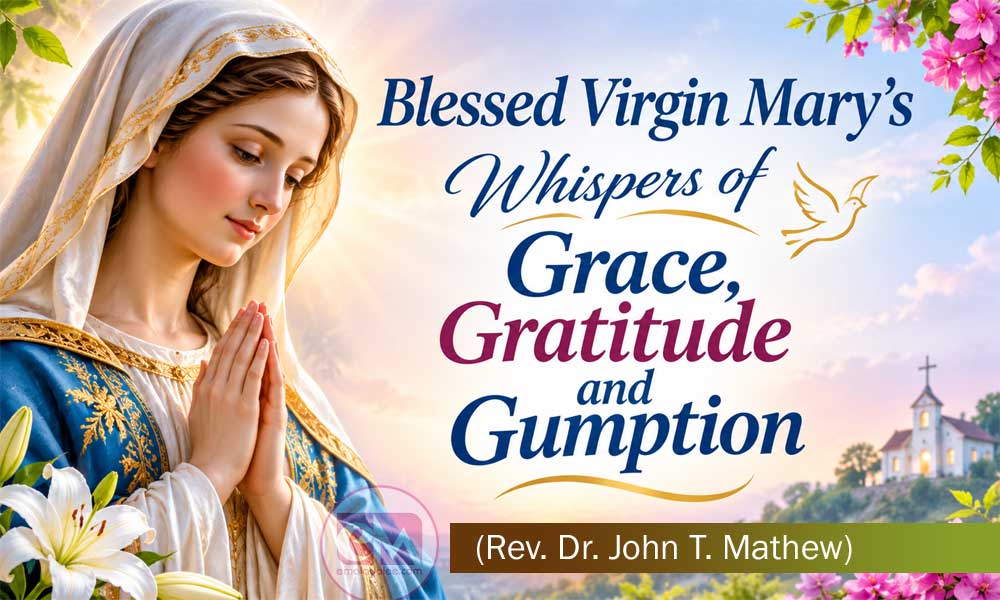
The Canticle of Virgin Mary, the earliest of eight ancient sacred hymns, is both a mandate of affirmation and a manifesto of rallying cry not only for the followers of Jesus but for every living, breathing soul in our stunning but ruptured world in a tailspin.
Advent, from Latin “adventus” meaning “coming”, is the season to reexamine the story of the Holy Family – Mary and Joseph – as they anticipated the birth of Jesus. This marks the dawn of global liturgical year to highlight the Nativity and Second Coming.
Just sometimes, things make a little more sense upon revisiting. The promising radical social reversal lyrics of Mary do not take on flabbiness or flatness especially when millions of innocent people grin and bear a global debacle of higher prices, inflation, loss of family, friends, employment, disrupted supply chains, trade wars, reduced global growth etc. Ralph Waldo Emerson in his 1841 essay on ‘Prudence’ said, “In skating over thin ice, our safety is in our speed.” In the spirit of reflection, Mary’s song of praise as well as prognosis of both right and duty has always been a brilliant fascination with its humbling at the same time emboldening spirituality. Mary offers a prophetic, risky, cathartic and galvanizing song for our self-analysis knowhow during the season of Advent prior to Christmas. Jesus is still in Mary’s womb; he is not here yet in our messed-up world.
The defining spark of the movement of the Good News of Jesus came about when two spunky Palestinian cousins, both pregnant, met in the village known as Ain Karim village. Two young women – one carrying John the Baptist and the other with Jesus; eventually the Good News transformed cultures and domains inside out; invariably all global empires ‘where the sun never sets’ nosedived into the annals of history.
Is this beloved Mary’s pensively dulcet hymn, or is it not rather a Jesus-centric utterance delivered by a mother on behalf of her son? Luke’s narrative (1:46-55) unequivocally attributes the words to Mary. An imaginative ‘dual authorship’ touches on a massive but insightful theological juggernaut that would bolster us to grapple with existential and divine nuts and bolts blissfully without unnerving untouchable ontological dogmas. A young pragmatic woman zeroed in on praising God, envisaging an imminent collapse of the evil empire and incentivizing those left on the margins, teaches us an expansiveness of humility.
While the New Testament directly mentions Mary twenty times, the Quran refers to her thirty-four times! Mary was not a patron of power but she turned imperial chaos into political hope for the world. Her amnic mantra of proclamation of policies and principles is very much like “a very good sermon with a good beginning and a good ending where they are as close together as possible."
In my native neck of the woods, baby boomers grew up with gruesome and unsettling memories of ‘royal and reserved’ trees – teak, rose wood, sandalwood and ebony - in our household were state property. We were imperialized or held back and sternly banned cutting or using them without written government sanction! In Edinburgh on my first day my classroom heritage desks crafted from teak and rosewood with sloping tops reminded me of an impressive colonial era architecture and heavy wooden furniture at the University College, Thiruvananthapuram. Still reeling after this unimaginably gruelling challenge to process an abrupt stripping away of trust shattering my newfound safe space with an emotional discomfort!
Besides a promising pursuit and attachment of a new place, community of classmates, professors, weather, scran and dram, Theology 101 was more about those stomach-churning mystery desks than the Bible. In 1970 at our Sunday high tea, celebrated journalist Malcolm Muggeridge who taught at Aluva Union Christian College in the 1920s, jibed with a grin, “a novice aspirant with Nasarani apostolic pedigree in the first century Saint Thomas heritage striving to delve into Presbyterian predestination is staggering.” In fact, Scottish porridge, Scotch egg and haggis were more palatable than theological rabbit holes of Augustine, Knox and Calvin. A flagrant discovery of a deadpan duplicity of the church in pillaging natural resources and looting the spices and hard wood from our property. The shady role of the British church in the acquisition of priceless Kohinoor,105.6 carats diamond, oddly now part of the crown jewels, was reprehensible.
The Song of Mary is saddled with an imported name, ‘Magnificat.’ The title ‘Magnificat’ comes from the first line of its Latin version. Magníficat ánima mea Dóminum (My soul magnifies the Lord). Neither Mary nor her elder cousin Elizabeth, to use a playful idiom, the partner in crime, did not contrive a chic caption for this unprompted upsurge of praise of a mystical whizz-kid, betrothed but unmarried, at the same time, startled yet resolved, teenager from Nazareth. As an aficionado of feminist theology, it helps to remember that Mary was resilient in her forlorn and murky village on the fringes of the evil empire where she pined for ‘sisu’, the Finnish concept of ingenuity, tenacity and chutzpah to push through dire straits.
Powerhouse singer and song writer Katy Perry sings “Woman’s World”.
It's a woman's world and you're lucky to be livin' in it
It's a woman's world and you're lucky to be livin' in it
You better celebrate (celebrate)
'Cause, baby, we ain't goin' away
It's a woman's world and you're lucky to be livin' in it
A finnicky shopper once weighed in: “I'm always down for a good deal with a little snack on the side.” Most traditional mainliners prefer a worship service where the Magnificat is part of the liturgy. In the anarchic flora and fauna of historical Palestine in the Levant where Mary, mother of Jesus, aka ‘Mother of God’, sang “my Saviour mindful of the humble has scattered those who are proud in their inmost thoughts, brought down rulers from their thrones but has lifted up the humble. God has filled the hungry with good things but has sent the rich away empty.”
The Bible-thumpers, who leave everything to G-d, are known to be cavalier about the existential realities of the down-trodden in the tyranny of the present fleeting world order and growing global animus prescribed by a few amateurish newly-wealthy millionaires. Recently a subterfuge request for $500.00 arrived on my desk from a group in England to help with Re-greening Africa programme. Between the 15th and 20th centuries, bigoted colonial powers and Arab traders stripped of Africa’s natural resources.
Archbishop William Temple’s manipulative missiology had misconstrued that he and his lackluster missionaries could swerve the brunt of Mary’s prophecy on those stripped off human dignity. Isn’t it comical that Mahatma Gandhi and his ardent followers had known that the Good News of Jesus was the straw that broke the camel’s back; however, amply flushed with his hubristic triumph prelate Temple did not. Temple had covertly known that his stealthy wealthy empire would fade away; yet he instructed his sycophants to bypass weekly reciting the Song of Mary due its potently activist metaphors that might incite the collapse of the marauding European colonialism! He warned: “Be careful not to sing the Magnificat. It’s a most revolutionary canticle!” Temple died in 1944, three years before India gained independence in 1947. Mahatma Gandhi requested it be read as the British flag was lowered. Decades later, when Justin Welby failed to demonstrate humanistic leadership by turning a blind eye to a sexual predator, was replaced by Sarah Mullally, first woman to hold the role!
Song of Mary transcends transactional bosses to the core ethos of human dignity, compassion and revolutionary nature of the Jesus movement. Therefore, an enthusiastic engagement to reach out to the world beyond us requires the foundational theological affirmation Mary offers us. We live in the digital era that creates and consumes information. The ancient heathen world risibly decreed “either a Caesar or nothing: either Emperor or nothing.” An obsolete catchphrase “aut Caesar aut nihil” is parroted by fly-by-night trust fund babies and shady plutocrats today! We have plentiful examples of depraved war hawks and hard-up political trumpery in leadership that get wiped out.
Our orphan world of street urchins, homeless people, abandoned children and unsheltered women we have categorically no decisive leadership. There are approx. 811 million people (one in ten people worldwide) live in abject poverty. Coincidentally, isn’t it disgraceful that affluent nations in the former Christendom brazenly gloat about billions of dollars being thrown away for voter bribery in order to keep electing and re-electing Machiavellian, unethical candidates to catbird seats?
The pre-Christmas bustle is all about our annual recap of our bred-in-the-bone faithfulness regarding our calling in the face of massive and sustained setbacks and provocations in the world around us. When a new savage imperialism expanded control over Africa, Asia and the Pacific to increase industrial economies in Europe and boost prestige and power in 1870 John Ellerton underscored that human empires would shrivel up.
“So be it, Lord! Thy throne shall never,
Like earth’s proud empires, pass away;
Thy kingdom stands and grows for ever,
Till all thy creatures own thy way.”
We live is a broken world predominantly led by mindless micro-managers who are incompetent and uncaring to help with the nitty-gritty issues of survival of people who live in abject poverty and in trepidation. It is heart-breaking to look at the world and observe such an abysmal gap of harsh realities people endure, evidently manifest violations of Mary’s song that fire up humanity.
It helps to discern what Mary’s Manifesto is not. It is not an absurd palaver of an emperor nevertheless it is the last nail in the coffin of the empire. Res ipsa loquitur, “the thing speaks for itself”; is a doctrine in common law. Similarly, the Song of Mary “speaks for itself’ while an archbishop was sweating the details to fight against a theology of justice with the same old, same old road map. Rabindranath Tagore taught us “You can’t cross the sea merely by standing and staring at the water.”
Without a doubt, the lonely thrill of reading theology at several divinity schools on both sides of the pond is a world apart from the liberating canticle of Mary which has been on the liturgical menu in most ancient traditions. Our antediluvian denominations, trapped in their pale prediction, appear to be dysfunctional by bottlenecks of tradition and culture; however, prophetic Mary and gaslit fans perch on the elevated balcony. Mother Mary’s imperative proclamation to the world is “don’t spit on me and call it rain” as her prophecy will ‘force quit’ enemies of humanity and remodel our world for all to live in hope, peace, joy and love.
Regrettably, our world has been marred by wanton violence and warfare driven by self-serving, aging autocrats. Undermining human dignity through deceit, they siphon away wealth by depriving the impoverished of life's basic necessities—all from behind their fleeting, ostentatious gates of grandeur. Blessed Virgin Mary’s whispers of gentle grit and enduring grace are the only “Hail Mary” for our polarized global landscape.
Victorian poet Christina Rossetti helps us to chill out:
“Our God, Heaven cannot hold Him, nor earth sustain;
Heaven and earth shall flee away when He comes to reign.
In the bleak midwinter a stable place sufficed
The Lord God Almighty, Jesus, our Lord.”
[The Rev. Dr. John T. Mathew, an ordained minister in The United Church of Canada, served several urban and rural congregations in Ontario, Canada since 1974 and taught in the Department of Religious Studies, Laurentian University, Sudbury, Ontario.
Mathew was awarded the Merrill Fellowship at Harvard University Divinity School and served as Pastor-Theologian at the Princeton Center of Theological Inquiry. He was Ecumenical Guest Minister at St. Machar’s Cathedral, Aberdeen (Church of Scotland) and Minister at St. Andrew’s Church in Gore, Southland, Presbyterian Church of Aotearoa New Zealand]

EMalayalee Available in MediaAppUSA



Copyright © 2024 emalayalee.com - All Rights Reserved.
Webmastered by MIPL, Web Hosting Calicut Kerala